Boynton Beach police will ask the City Commission on Tuesday to keep, curb or replace Flock plate cameras. Data is now kept 7 days; 39 of 47 cameras run.
The Boynton Beach Police Department will ask the City Commission on Tuesday to decide the future of its Flock license plate cameras. Staff want direction on three paths: tighten how Flock is set up, partly suspend the system, or seek bids from other vendors.
Updated Oct. 15: The commission did not decide on Oct. 6. It asked the city attorney for a summary of its contract options, and the cameras return to the agenda Tuesday, Oct. 20, with six options. Read what commissioners will choose from.
The request is item 3.G on the agenda for the regular meeting at 6 p.m. Tuesday, Oct. 6 at City Hall, 100 E. Ocean Ave. Commissioners asked for the presentation by consensus.
What the police department is asking for
The agenda item asks the commission to:
- endorse updated policy limits and a plan restricting who can use the system
- confirm how the data is shared and how long it is kept
- choose a procurement path: tighten Flock’s configuration, partly suspend it, or run a competitive evaluation toward another vendor
Staff wrote that removing the cameras “would significantly slow investigations.” The item says the program is already budgeted, so Tuesday’s decision carries no new cost.
The cameras and the rules
The department operates 47 Flock cameras, according to its presentation to the commission. Thirty-nine are working and eight are waiting on permits. They take still images only, with no video or live view.
The department lists changes it has already made:
| Change | Before | Now |
|---|---|---|
| People with system access | 202 | 171 |
| How long plate data is kept | 30 days | 7 days |
| Who the data is shared with | a broader network | Florida law enforcement agencies only |
Every search now needs a case number, an offense type and a stated reason. That is in the department’s written camera policy, IC 1902, revised Sept. 28. Internal Affairs audits five randomly chosen user accounts each month. An alert alone cannot justify a traffic stop: officers must check the plate by eye and confirm it through state and national databases first.
The presentation cites three September cases where a camera alert helped officers. One was a person reported missing through the Palm Beach County Sheriff’s Office, who was found safe.
What the city attorney says
City Attorney Shawna Lamb’s office sent the commission a legal memo dated Oct. 2. It calls the legal risk of continuing “moderate and rising.”
The memo’s main points:
- State highways. The Florida Department of Transportation revoked approvals for plate readers on state highway rights of way in an Aug. 31 memo. Agencies had until Sept. 30 to remove them. The city has asked Flock to remove every city camera on state right of way. Flock owns the hardware, so only Flock can move it, and staff will report back.
- The county. The Palm Beach County Commission discussed pausing new camera permits on county rights of way and held a workshop Sept. 30. The memo says the county has not yet issued formal direction.
- Neighbors. The memo says no agency in Palm Beach County has ended its program. It lists the Sheriff’s Office and the police in Delray Beach, about five miles south, and Lantana, about four miles north, among those still running cameras.
- The contract. The Flock agreement runs through the 2027-28 budget year. The city can end it on 30 days’ notice without penalty if the commission stops funding it.
- Flock’s own rights. The contract lets Flock use anonymized city data indefinitely, including to train machine-learning models. It also lets Flock disclose footage itself in some cases, outside the police chief’s approval process.
- Sharing limits. Any limit on outside access must apply equally to every agency, federal ones included. A rule that singled out immigration agencies would invite a claim under Florida’s Chapter 908, the memo says.
The memo recommends the city seek breach-notification terms and data-breach indemnity from Flock, and amend the order form to show the seven-day retention.
What other vendors would cost
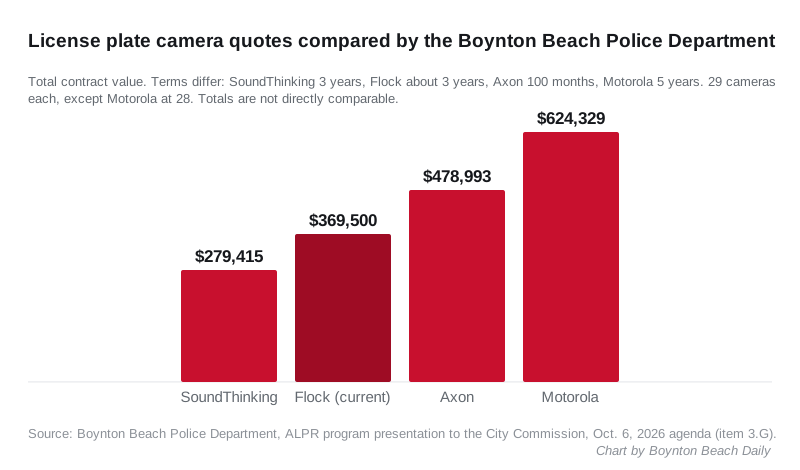
The department priced three alternatives. Terms differ, so the totals are not directly comparable:
- SoundThinking: $279,415 over three years for 29 cameras
- Flock: $369,500 across three orders of about three years each, for 29 cameras
- Axon: $478,993 over 100 months for 29 cameras, including poles and installation
- Motorola: $624,329 over five years for 28 cameras, including hardware
Staff’s own per-camera comparison found Axon cheapest per year once costs are spread across each term. Flock and SoundThinking came out close together, at about $3,000 to $3,100 a camera a year.
Also on Tuesday
The regular agenda includes:
- The Pierce. The developer of this approved downtown project wants to change one condition. The project has an eight-story building with 300 apartments and 17,089 square feet of commercial space on 3.04 acres. The request would drop a requirement to replace streetlights along Boynton Beach Boulevard. It would also swap planned 20-foot aluminum poles on Ocean Avenue, Northeast Fourth Street and Northeast First Street for 23-foot concrete poles. The commission approved the project March 9, 2023, according to the agenda item.
- Neighborhood parking. Commissioner Aimee Kelley asked for a discussion of the city’s parking rules. The item cites years of complaints about cars parked in yards, on sidewalks and blocking roads.
- A first reading of Ordinance 26-028, which would create a zoning category for personal instruction and consultation services.
- Water system purchases, including brass and pipe fittings up to $750,000 a year for five years, and control system support up to $150,000 a year.
A special meeting is called for the same evening, also at 6 p.m. The special agenda has two items:
- Vice Mayor Thomas Turkin asked to discuss city and Community Redevelopment Agency help to salvage and move the historic Oyer sign from the west wall of Hurricane Alley. A contractor’s proposal in the packet, dated April 22, prices the work at $131,846.50. That figure excludes the structure at its new home.
- A discussion of the transition of the agency’s legal team.
The commission will also announce the city’s Fall Festival, 3 to 6 p.m. Saturday, Oct. 17, at Centennial Park, 120 E. Ocean Ave. See things to do for more.
What it means for you
- To speak on the cameras or anything else, attend in person or join online. Public comment is limited to three minutes. Instructions are on the city’s YouTube channel under each meeting video.
- To watch only, use the city’s meeting video page.
- For help or accommodations, call the City Clerk’s Office at 561-742-6060 at least 48 hours ahead.
- If you drive in Boynton Beach, the department’s policy now keeps camera data for seven days. The full rules are in policy IC 1902, linked above.
We will report the commission’s decision after the meeting. For police activity, see our Police and Fire log.
Have your say